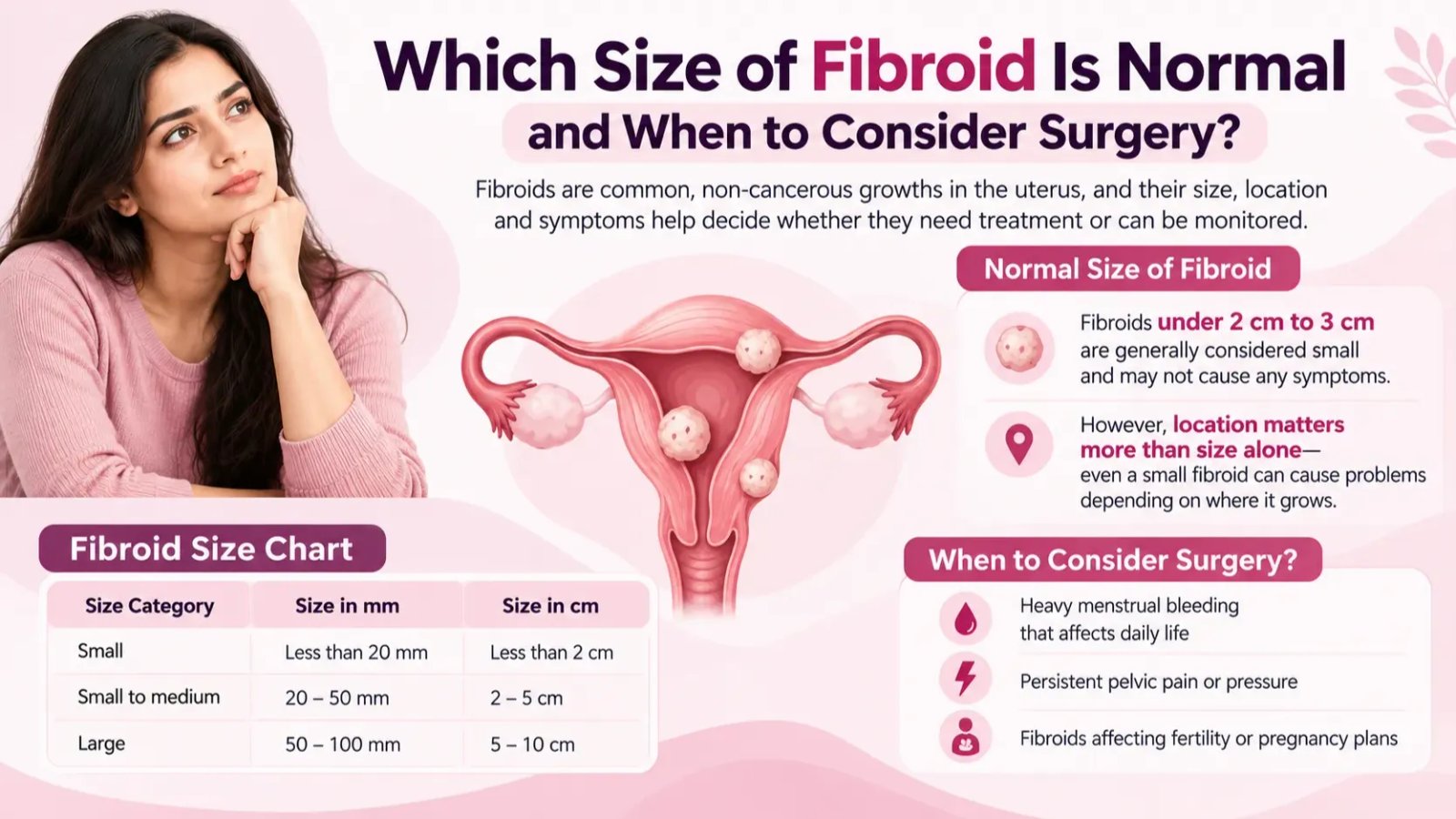
Discovering a uterine fibroid during an ultrasound can raise questions about its size, potential risks, and whether surgery is necessary. Fibroids under 2–3 cm are generally considered small and may not cause any symptoms. However, size alone does not determine whether a fibroid needs treatment its location can be even more important. Even a small fibroid may cause heavy periods or fertility concerns if it grows near or into the uterine cavity, while a larger fibroid may not cause significant problems.
In this blog, we’ll explore fibroid sizes in millimetres, which symptoms to watch for, and when to consider treatment or surgery.
What Is a Uterine Fibroid?
Fibroids are benign tumors formed within or attached to the uterine walls. These are made of connective tissues and muscles, and can range from a few millimeters to a few centimeters in size.
Based on the position of the fibroid, there are four types of fibroids:
- Intramural fibroids – These are located in the uterine wall.
- Submucosal fibroids – Fibroids found under the uterine lining which may even protrude into the uterian cavity.
- Subserosal fibroids – Found in the outside layer of the uterus.
- Pedunculated fibroids – Found in the uterus via a stalk.
Sometimes, the position is equally as significant as the size.
Fibroid Sizes Chart in mm
Fibroids are measured in millimetres (mm) or centimetres (cm) during imaging tests such as ultrasound. The following fibroid sizes chart in mm provides a general guide.
These are descriptive categories, not official medical stages or fixed treatment thresholds. A fibroid measuring 20 mm may cause significant bleeding if it affects the uterine cavity, while a larger fibroid may cause few symptoms.
Which Size of Fibroid Is Normal?
There is no medically established normal size of uterine fibroids since these growths are abnormal and are not a part of the uterus itself.
A small fibroid of less than 2-3 centimeters is usually found accidentally by performing ultrasound. If the fibroids don't provoke any symptoms or interfere with pregnancy, your physician will probably suggest monitoring without treatment.
Nevertheless, the normal size of fibroids in millimeters shouldn't be the only criterion you follow when taking decisions about treatment. A small fibroid close to the lining of the uterus may provoke heavy bleeding and affect your fertility, whereas a big fibroid situated in the outer layer will mostly provoke pressure symptoms.
In any case, all factors are taken into account by your doctor.
Which Size of Fibroid Is Dangerous?
It is common for women to wonder about the size of a fibroid that should be considered dangerous because they fear that a big fibroid could be a risk factor. Nonetheless, no particular size is an automatic risk factor in a fibroid that will make removal necessary.
Big fibroids pose a higher likelihood of pressing against other organs and causing feelings of abdominal bloating. However, smaller fibroids can still cause some problems based on where they are located.
Seek medical consultation in case you have:
- Abnormal menstrual bleeding
- Weakness, dizziness and fatigue that could point to anaemia
- Pelvic pain and pressure
- Increased need to urinate and inability to void your bladder
- Constipation and inability to pass stool
- Infertility and concerns of recurrent miscarriage
Fibroids are usually harmless. Post-menopausal growth and changes in symptoms require a checkup by a health professional but size and growth cannot prove cancer in a fibroid.
Is a 3 cm Fibroid in the Uterus a Cause for Concern?
A 3 cm fibroid in the uterus is a fibroid which measures 30 mm and doesn’t necessarily imply a serious situation or an immediate surgery.
If a 3 cm fibroid is asymptomatic and does not interfere with the uterine cavity, then observation alone can be sufficient. But a submucosal fibroid of the same size can lead to heavy periods or infertility.
If you are planning for pregnancy, consult your gynecologist regarding the location of the fibroid. The treatment or observation plan should depend on your ultrasound results and symptoms.
When Should You Consider Fibroid Surgery?
Fibroid surgery can be an option if the symptoms have been causing considerable impairment to your quality of life or if the fibroids cause any medical problems.
Surgery may be suggested by your doctor if you are having:
- Excessive menstrual bleeding leading to anaemia or not responding to drug therapy.
- Pelvic pain or pressure on nearby organs.
- Fibroids distorting the uterine cavity, affecting fertility.
- Persistence of the symptoms in spite of proper treatment.
- Features of fibroids such as size, position requiring further treatment.
A fibroid greater than 5 cm is not necessarily required to remove it. Equally, a smaller fibroid might also need treatment because of the symptoms.
How Are Uterine Fibroids Diagnosed?
The gynaecologist could ask you to undergo the following examinations:
- Pelvic exam: In order to evaluate any increase in the size of the uterus.
- Ultrasound: To ascertain the size and number of the fibroids.
- MRI scan: To obtain further information where required, especially before undergoing a complicated surgery.
- Blood tests: In case you have heavy periods, to see if you suffer from anaemia.
Conclusion
The size of the fibroid does not dictate treatment. A small fibroid may cause symptoms if it is in a problematic location. Larger fibroids may not cause problems and may not need treatment. The location of fibroids is not the only factor that helps decide on treatment. The findings of an ultrasound, the pattern of your bleeding and the pain that you feel are some factors. Sometimes the plan of a woman to get pregnant may impact the decision to treat fibroids. If you have fibroids or have heavy periods and pelvic discomfort, you should consult Dr. Sonu, one of the best Endometriosis surgeon in Lucknow. This may help you decide on treatment for your condition.
Frequently Asked Questions (FAQs)
1. What is the normal size of a uterine fibroid in mm?
There is no medically defined normal size for uterine fibroids. Fibroids smaller than 20 mm (2 cm) are generally considered small, but their significance depends on their location, symptoms, and effect on the uterus.
2. Is a 3 cm fibroid in the uterus dangerous?
Not necessarily. Many 3 cm fibroids do not cause symptoms or require immediate treatment. However, a fibroid near or within the uterine cavity may cause heavy periods or affect fertility.
3. At what size should a fibroid be removed?
There is no fixed size at which every fibroid must be removed. The decision depends on symptoms, location, growth, response to treatment, and pregnancy plans.
4. Does a 5 cm fibroid require surgery?
Not always. Some 5 cm fibroids can be monitored, while others may require treatment if they cause heavy bleeding, pelvic pressure, pain, or fertility-related problems.
5. Can uterine fibroids shrink without surgery?
Yes, some fibroids shrink naturally after menopause as hormone levels change. Certain medications may also temporarily reduce fibroid size or manage symptoms. The appropriate approach depends on individual circumstances.
6. Can I get pregnant if I have uterine fibroids?
Yes, many women with fibroids can conceive and have healthy pregnancies. However, fibroids that distort the uterine cavity or affect its function may interfere with fertility, so assessment by a gynaecologist is advisable.
7. Which type of fibroid is more concerning?
Submucosal fibroids, which grow into the uterine cavity, can be particularly relevant to heavy menstrual bleeding and fertility problems. However, the significance of any fibroid depends on its size, location, symptoms, and individual circumstances.
8. What are the symptoms of a large uterine fibroid?
Larger fibroids may cause heavy or prolonged periods, pelvic pain or pressure, abdominal fullness, frequent urination, or constipation. Some fibroids, however, cause few or no symptoms regardless of size.
9. How do doctors determine the size and location of fibroids?
A pelvic ultrasound is commonly used to identify fibroids and assess their size, number, and location. An MRI may be recommended when more detailed information is needed for diagnosis or treatment planning.
10. When should I consult a gynaecologist for fibroids?
Consult a gynaecologist if you experience heavy periods, persistent pelvic pain, pressure symptoms, or difficulty conceiving. If you are looking for the best Endometriosis surgeon in Lucknow and also have fibroid-related concerns, Dr. Sonu Singh can help assess your gynaecological condition and discuss appropriate treatment options.
About Dr. Sonu Singh
Dr. Sonu Singh is a Senior Consultant Gynaecologist and European-trained Minimal Access Surgeon in Lucknow with over 14+ years of clinical excellence. She completed advanced fellowships in Verona, Italy, and Bordeaux, France, specializing in nerve-sparing endometriosis excision, fertility preservation, and complex gynaecological laparoscopy.
Clinic: Gomti Nagar, LucknowCategories
Browse by clinical specialty